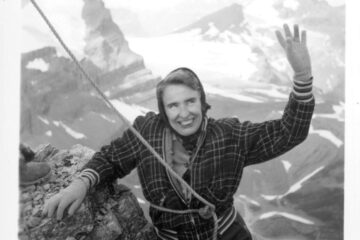
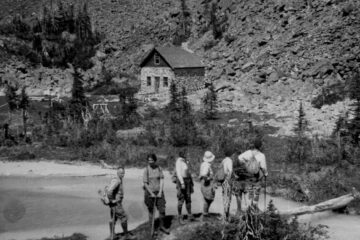
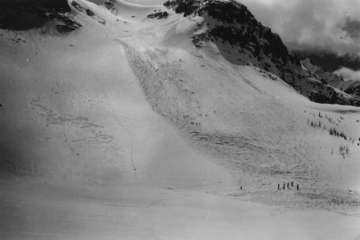
Don Campbell (1920 – 2002) was an enthusiastic member of the Edmonton section, and wrote about his early experiences in the club in this article. He joined the Alpine Club of Canada (ACC) at the age of sixteen, adventuring out on climbs with Edmonton section founders Cyril Wates, Helen Burns, Rex Gibson, Dr Harry Bulyea, and others. He was a frequent photographer of activities and mountain landscapes on club trips. Despite a shoulder injury that had limited his climbing, he completed a 30 year dream of summiting Mount Victoria in 1970.
My interest in mountain climbing led to my becoming associated, in the spring of 1937, with the Edmonton Section of the ACC. Dad (Dr. J.W. Campbell, math professor, U of A) knew that amateur astronomer Cyril G. Wates was a member of the club and arranged for me to be introduced. In the three years prior to my entrance into university, and the outbreak of the Second World War, I developed into a most enthusiastic member.
In those days, the membership including associates numbered approximately fifty, with men and women being equally divided. Weekly hikes were held in the spring and fall, for fitness training and sociability. During the winter, weekly excursions were made to our hut near the mouth of the Whitemud Creek to ski on our ski hill. And, of course, the highlight of the year was the last two weeks of July, when the ACC’s annual camp was held somewhere in the Rockies or Columbias.
The core of the Section was a group of half-a-dozen individuals, including C.G. Wates (the “Skipper”), Rex Gibson (known as “Cap’t”), H.E. Bulyea (Sir Geik), and H.A. (“Helen”) Burns. One of them was always on the executive, and two, Wates and Gibson, became ACC Presidents.
Events in the Section were advertised and coordinated through a newsletter called The Mountain Breeze, published bi-monthly. This was typed and mimeographed, hand addressed, and then mailed for one-cent postage, I believe.
My first outing with the Section was in May, 1937. It was probably a hike out to our hut at Whitemud, called the Terwillegar Hut. Meeting at Steen’s Drug Store on 88th Avenue and 109th Street, near the south end of the High Level Bridge, we followed a trail along the River Valley, constructed by unemployed men during the Great Depression. The path was well built and scenic, and included some log bridges over ravines.
Our destination, the hut, was in a ravine on a farm owned by Dr. Terwillegar. It had been constructed by the Section a few years before, and was the scene of many enjoyable “get togethers” after rambling around the neighbourhood. Work parties were held during the summer to clean or repair our hut. One summer, I assisted Dr. Bulyea with the building of a fireplace. He brought large rocks in from somewhere and found a large pine along the river trail to use for making the mantel. My chief job was to mix cement for him, as he slowly built up the fireplace, chipping and fitting the stones into place. It was crowned with a trilobite from the fossil beds on Mt. Stephen.
Most of the section hikes were held in the countryside surrounding the city. They included such places as Conjuring Creek, Beverly Bluffs, Berrymore Ferry, and Rabbit Hill. We usually met at Steen’s and then drove to the start of the hike. The hikes, with prior permission of the land owners, generally followed roads, lanes or fence lines, and avoided ripening crops. At our destination, a small fire was built and by means of two forked sticks and a stone, a support was made for a “Billy” can filled with water, to make tea. After sitting round the fire munching on sandwiches, we often helped Rex finish the weekly Times of London crossword puzzle. It was very difficult and often our combined efforts were insufficient to complete it.
Another activity was a sing-song based on “Songs of the Edmonton Section.” Among other things, the Skipper was a talented songwriter, and had composed the Edmonton Section song. About this time, I acquired a mouth organ and was able to provide accompaniment. Altogether it was a very satisfying experience, ending with “All Through the Night” as the embers of the fire burned low and sunset streaked the sky.
Perhaps the most outstanding hike of the year was to the Glory Hills, north of Stony Plain. The hike traversed a lake-dotted, tree-covered rolling upland. This area was at its best in the fall, when autumn turned leaves of poplar and birch to golden yellow. Thus, our hike was usually held in early October. There were no roads through the hills, so we would split into two parties, starting from opposite sides of the hills, meeting in the center for lunch. Then, we would continue to the other side, driving each other’s cars home. This annual hike, with its picture perfect vistas of lakes, trees and sky, and intriguing names, such as Lake Mere and Heatherdown, was a perennial favorite. On isolated farms, you could still see grain in stooks1 and picturesque farmsteads. Only memories now remain of a truly gorgeous area in its pristine state.
During the winter and early spring, house parties were often held at members’ homes. There were games of various kinds and of course scrumptious eats. Another highlight of the year was the Annual Banquet, held at the Corona Hotel [107th Street and Jasper Ave, south side of avenue, hence the Corona Station of the LRT]. There were usually about one-hundred people present. Often guests came from the Calgary Section. A roast turkey dinner was followed by toasts, reports, entertainment, and a guest speaker. I once replied to the Toast to the Club and Sister Sections. And once I provided the entertainment by playing a piano solo. I can remember that another soloist was Mrs. Charlie Brine [Margaret Gold Brine], who had a lovely singing voice. She was, I believe, the third woman to climb Mt. Robson. The speakers were usually climbers. One I remember particularly well was Sydney Vallence of Calgary. He showed some of the first colour pictures I ever saw. They were of the region around Lake O’Hara.
To the Alpine Club of Canada, and the Edmonton Section in particular, I owe my enthusiasm for hiking and climbing and my love and knowledge of Nature. These things, and the friendships, have stayed with me long after I stopped climbing.
Photos:
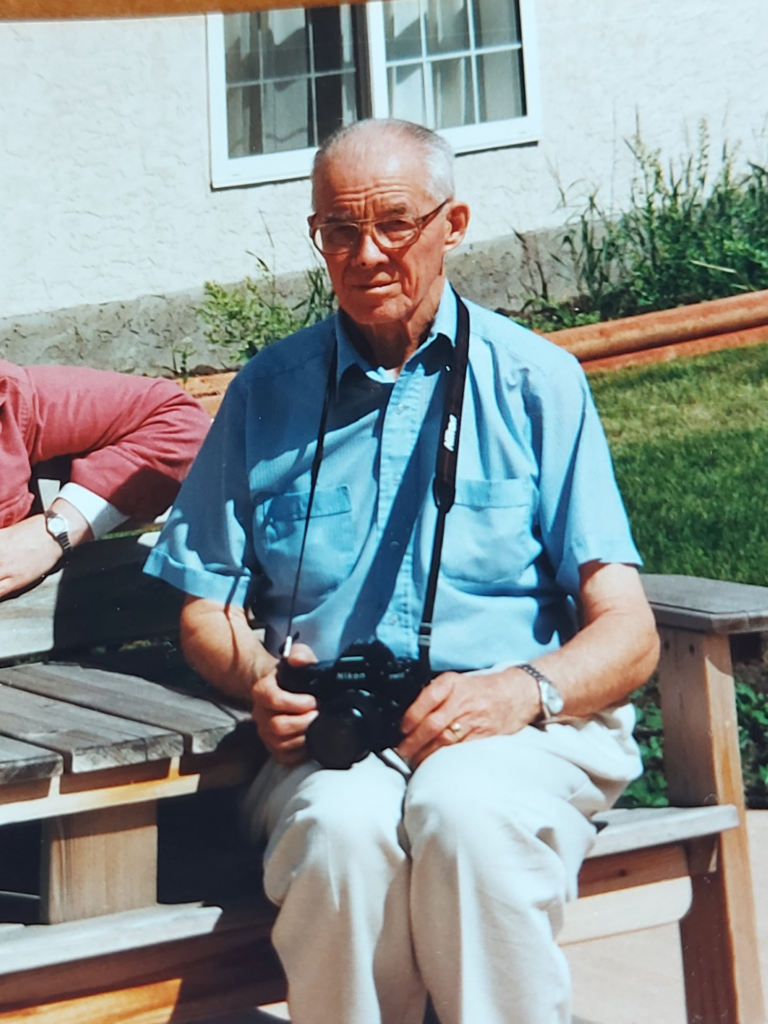
Donald K. Campbell, age 79.
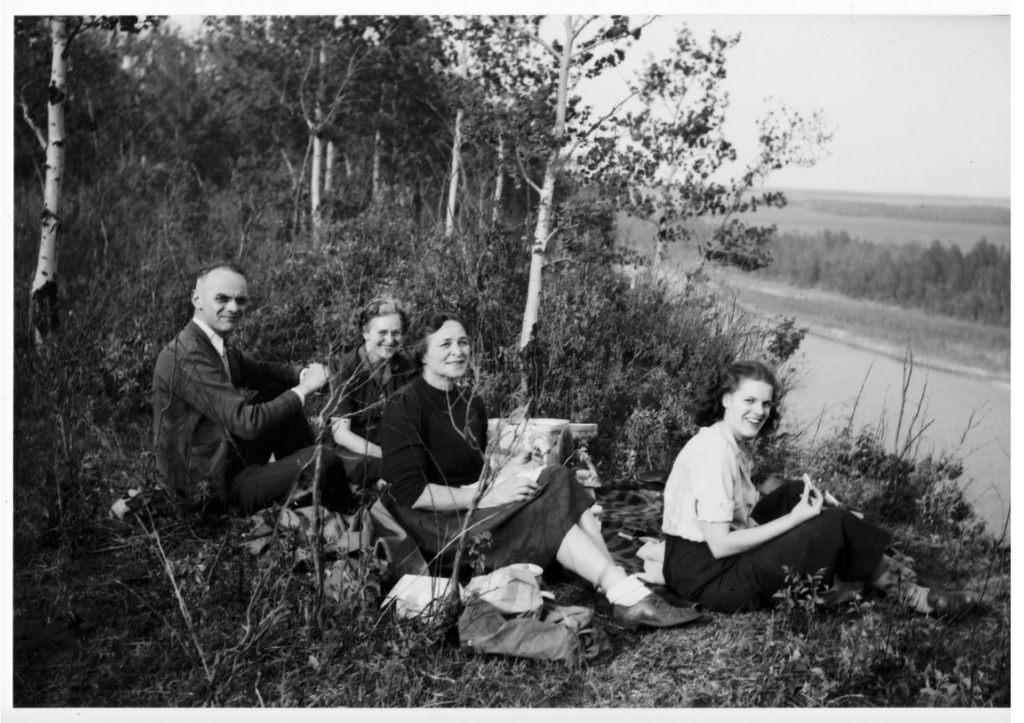
Lunch on a hike with a view of the river, late 1940’s. Doris Campbell is on the right.
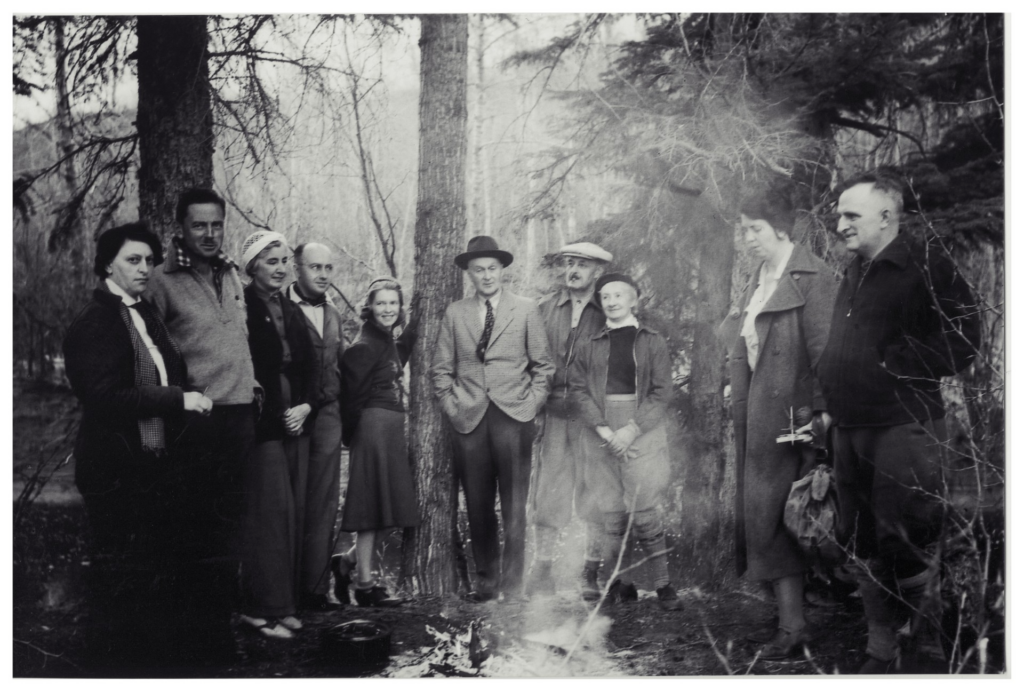
A hiking group around a fire for making tea, late 1940’s. Helen Burns and Cyril Wates are on the right.
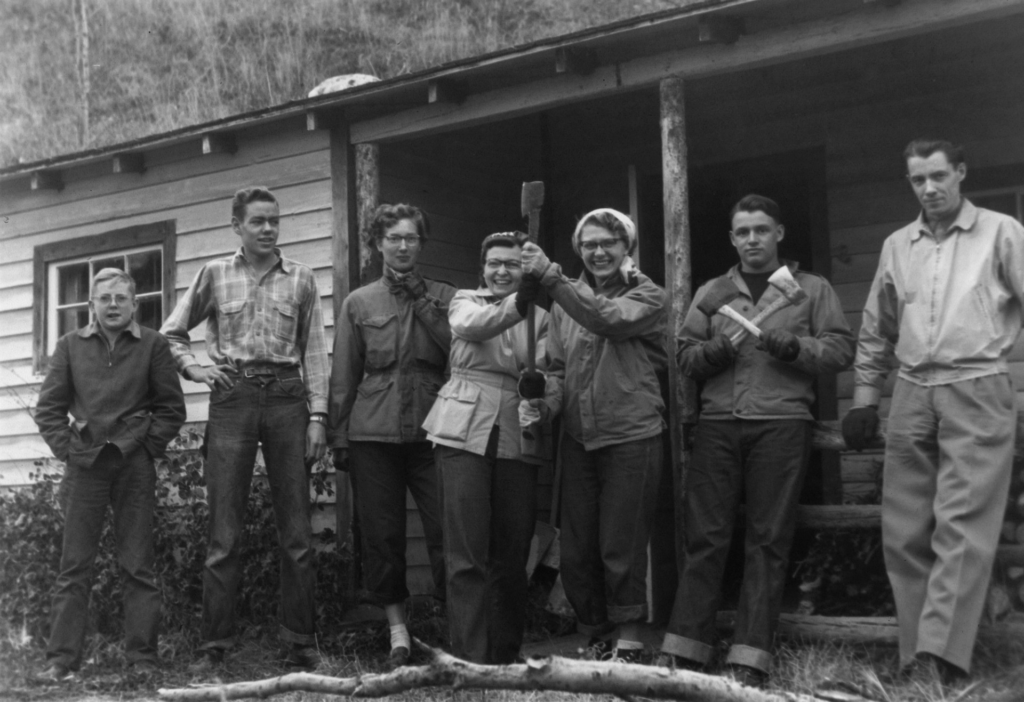
Don Campbell (far right) at the Whitemud Hut.
- Fields were still being harvested with manual labor back then. Barbara Campbell, Don’s daughter, notes that the word stooks used in the description of the fall colour hikes east of the city is correct.
“For your readers, before “combines” which do all these things at once, the crop was cut off at ground level, the stems with heads of wheat were “stooked” by hand into little pyramids to dry and to await threshing. The threshing machine was brought to the field, and a large crew of men would bring the stooks to the threshing machine, and feed them into it. The machine stayed in one place. The output was wagons of threshed grain, and piles of straw. Then all of this had to be transported off the field. The machines that do this today are called combines (noun) because they combine (verb) all these steps into one. So stooks are a vintage way of handling a crop.” ↩︎
Article submitted by Barbara Campbell, daughter of Don Campbell and a Life Member of the ACC, who lives in Saskatchewan. She can be reached at bjacampbell@sasktel.net.