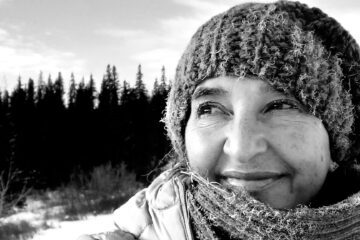
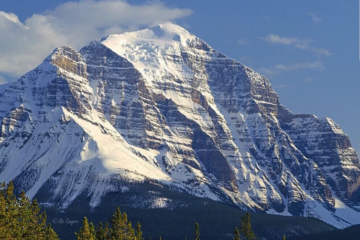
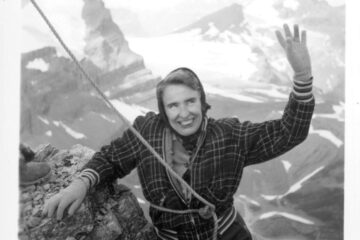
Don Campbell (1920 – 2002) was a long time member of the Edmonton section, joining the Alpine Club of Canada (ACC) at sixteen. He worked in Lake Louise when he was nineteen and climbed Mt. Hector, Mt. Temple, Mt. Weed, Mt. Fairview, and Devil’s Thumb the summer of 1940. He was drawn to Mt Victoria, memorizing the mountain’s details, but did not have an opportunity to climb the 3464 metre height that year. The years passed – he went to university, was in the army, started work and married. Once he had the time he returned to climbing, but a shoulder separation limited his activities to hiking and skiing. He continued to dream of Mount Victoria, though, and thirty years later, in 1970 he finally fulfilled his dream.
– Michele Eickholt (Section Admin)
Saturday, the first day of August, 1970, will always live in my memory as one of the most thrilling days of my life, for, on that day, under perfect weather conditions, and in the company of a most delightful person, I climbed to the very tip of the main summit of Mount Victoria, the snow and ice mountain that forms the magnificent backdrop for Lake Louise. This was the realization of a thirty-year-old dream, born in 1940, when I worked for the summer at Lake Louise, and got to know intimately the peaks and lakes and trails of this incomparable mountain region. Mount Victoria, however, was the supreme attraction, and I spent many hours memorizing its every detail from the lawn in front of the Chateau, or from the trail along the lake.
Mount Victoria has been described as the classic climb in the Rockies. The mountain is magnificent in proportion, being about two-and-a-half miles long, and rising more than a mile above its base. Although only rated as moderately difficult in climbing circles, there is no easy way up it, and to do it in a day by any one of the three main routes involves a climb of at least ten hours. On two of the routes, from Lake Louise via Abbot Pass, and from Lake O’Hara via Huber Glacier, there is about every variety to be found in climbing a high mountain – rock, ice, and snow climbing – and the latter part of the climb, along the summit ridge, is among the most spectacular to be found anywhere.
I had joined the Alpine Club of Canada in 1937 as a boy of sixteen, and had attended three summer camps, and done a considerable amount of climbing by the summer of 1940. I had also read extensively in books on the Rockies, and in Alpine Club journals, about the exploration of the Rockies, and knew almost by heart the records of the first ascents of the various peaks. Thus it was quite a thrill to find myself working at Lake Louise that summer so close to the great peaks which I had come to love with an intense passion. And Mount Victoria, which I could see daily from the service station where I was working, drew me irresistibly, like a magnet, and I knew that someday I must tread its summit snows.
The years passed, and I graduated from university, spent several years in the army, returned home and went to work, and got married, and generally settled down. For ten years after the war, I climbed quite regularly, mainly in the Jasper area. Then, an acute shoulder separation left me with very restricted movement of my right arm. Feeling that I should not endanger my friends in the club, since climbing requires the full use of both arms and both feet, I discontinued climbing, although continuing to hike and ski.
However, thirty years after my first summer at Lake Louise, I found myself in that area again, taking a holiday by myself, hiking and taking pictures. The old urge to get on the heights again possessed me once more, and I decided to follow up a possibility which had occurred to me a few years before – that of making a climb with a professional guide, who might be willing to accept any increased hazard or inconvenience due to having me along. Accordingly, I checked with offices of guides in Banff and Lake Louise, and finally made the acquaintance of Bernie Schiesser, area manager for Louise Lifts. On learning of my climbing experience, and having my assurance that I was in reasonably good physical shape, he felt that I could do a peak like Victoria, since the rock work involved did not consist of any steep hand-over-hand climbing.
I spent the next few days hiking to get in condition, and searching for a companion to share the cost of the climb. In the latter, I was unsuccessful, and finally decided to climb alone, anyway, in order to be free to set my own pace, and to take as many pictures as I wanted to, photography being my number one hobby. So on Friday, July 31, I returned to Louise, looked up Bernie, and made a firm commitment to do Victoria with him the next day.
Bernie has a private climbing camp, called “High Horizons,” at Lake O’Hara, and, because of this, and the fact that the Huber Glacier Route was the one in the best condition, he decided that we should make the ascent from his camp. Accordingly, at 6:00 p.m., we caught the Brewster bus at Lake Wapta, and went in the eight miles to Lake O’Hara, where we had supper at his camp, and retired early.
The next morning, we were up by 4:00 o’clock, and, after a substantial breakfast, we were on our way by 5:00. Although the sun was not up, the sky was clear, and there was every indication that we would have full cooperation from the weather.
From the alpine meadow, where his camp was located, down to the lake was an easy quarter mile by trail, and we then followed the Lake Oesa trail for another quarter mile along the north shore of the lake. From here, we took the route for Wiwaxy Gap, and the steep trail took us rapidly up through the trees and beyond timberline to the gap, at an elevation of just under 8,000 feet. Looking back, we got some magnificent views, with the first sunlight striking Mounts Lefroy and Hungabee, and Lake O’Hara lying like a jade green jewel in the forest, almost 1,500 feet below.
From Wiwaxy Gap, we followed the high trail toward Lake Oesa for a short distance, and then turned left up the west ridge of Mount Huber. We shortly reached some steep cliff bands, and stopped to put on the climbing rope. We would remain tied together by this rope, for mutual safety, until we returned to this vicinity, some twelve hours later.
The rock was firm, and we climbed rapidly, gradually traversing to the north, aiming for the Huber Glacier at a point just above the icefall. At the edge of the glacier, we stopped once again and put on our crampons, sharp spikes approximately one and a half inches in length, made of lightweight metal, to give us increased traction on steep ice and snow.
We made rapid time on the glacier, and finally, shortly after 9:00 o’clock, we emerged from the shadow of Mount Huber into brilliant sunshine. A short while later, we stopped on the ice for a breather and a second breakfast. Here, at an elevation of some 9,500 feet, the views were tremendous. The south face of Victoria, crowned by the glistening summit which was our goal, loomed 2000′ above us, and to the west, peaks thirty and forty miles away were rising above the nearby ranges.
Continuing up the glacier, we had to be constantly on the watch for crevasses, since the warm weather of the previous month had softened the snow bridges. Most of the time, we crossed the crevasses by jumping over them, after determining, by probing with the ice axe, where there was firm ice on the other side.
From the glacier, we passed onto the snowfield and finally reached the col, or saddle, between Mounts Huber and Victoria. Here we turned left, and headed for the face of Mount Victoria. Before getting on the face, however, we had to pass an obstacle which can, on occasion, prove insurmountable, namely the bergschrund. This is the large crevasse where the glacier breaks away from the mountain, and the difficulty arises partly from its width (up to ten or fifteen feet) and partly from the fact that the upper edge overhangs the lower edge by as much as ten feet. Fortunately, we found a snow bridge, caused by small avalanches filling it in, which was solid enough to take our weight.
After passing the bergschrund, we ascended a steep snow slope, and then entered a steep snow- and ice-filled gully, or couloir, which extended some five hundred feet up to the ridge. This was the steepest part of the climb, and we could only go for a few minutes without a breather. The altitude (well over 10, 000 feet) was also beginning to have an effect.
Finally, we could see a notch in the ridge above us, and, in a few minutes, we were standing on the summit ridge of Victoria, at approximately 11,100 feet. I had read about the view from this ridge, and been told about it, but I was still unprepared for the sight which burst upon my eyes as I raised my head above the notch, and gazed down the other side. There, 5,000 feet below, and some six miles away, was Lake Louise, looking like a green tear, cupped in the rocks and trees of the valley. From the ridge, the face fell as steeply toward the north as the one we had climbed from the south. And to the right were the snow covered precipices of Mount Lefroy, plunging some 3,000 feet to the depths of the lower Victoria Glacier. It was absolutely a breath-taking view, and, to me, was worth all the effort of getting up there. It was now 12:00 noon. We had been climbing steadily for seven hours.
At the notch, we removed our crampons, since the ridge climb to the summit, visible to the west as a beautiful snow cone, involved a considerable amount of rock, and the crampons would have been hazardous. It is important in climbing to understand conditions, and use equipment only when it will afford additional protection. In 1954, four Mexican women climbers were killed descending Mount Victoria, when they used crampons to descend a steep snow slope which had been softened by the afternoon sun. The crampons got packed with moist snow, and they then had no protection. When one of the girls slipped, the other three were pulled off their feet, and the entire rope fell to their death on the lower Victoria Glacier, some 2,500 feet below.
As we started our climb toward the summit, I had my only anxious moment on the climb. The ridge is very exposed, as they say in climbing circles, being a maximum of five-feet wide, and with a drop of 2,500 feet to the right and 1,500 feet to the left, the slopes in each case being approximately 50 degrees. And just west of the notch, the ridge narrowed to a width of two feet. I wasn’t certain at first whether I could do it standing up, or would have to get down on my hands and knees. However, I gave it a try, and by stepping very cautiously, I was able to make it to a point some thirty feet on, where the ridge widened out. This was the first time in seventeen years that I had been up on a mountain like this, and it takes a little while to get your confidence back. Returning from the summit, I passed over this same place without noticing it.
The climb along the arête, or ridge, of Victoria was, by all odds, the most spectacular bit of climbing I had ever done. We were literally walking along the ridge-pole of a roof – the roof of the continent. As we ascended toward the beckoning summit, we had one foot in B.C. and the other in Alberta, and were straddling the Great Divide, or continental watershed, streams on the O’Hara side draining to the Pacific, while those on the Louise side drained to the Atlantic. The snow was a dazzling white, and the sky a deep blue. Far below, the mountains were soft and hazy. A gentle breeze was blowing, and the air was fresh and cool. I literally felt suspended between heaven and earth, and I had a feeling of freedom and exhilaration such as I had never experienced before. The four-and-a-half hours that we spent on the summit ridge were one long glorious rapture for me, something which I will never forget, and, which, in memory, will always quicken my heart and mind.
Rock and snow alternated with each other, and, on the whole, we kept right on the ridge crest. At one point, however, where the snow was too sharp, we traversed on the Lake O’Hara side, kicking steps in the steep slope, and belaying each other with the rope. The snow scoop on the ice axe was used to assist in making firm steps, and the ice pick had to be used on one occasion when ice was discovered just below the surface of the snow.
Finally, the snows of the summit loomed ahead, and then, at 1:30 p.m., we climbed the last snow slope, and stood together on the very highest point of Mount Victoria, at an elevation of 11,365 feet above sea level. We shook hands, and got several pictures of each other, and then I stood by myself on the summit for a few minutes, while Bernie went to the cairn, a few feet down to the west and started his lunch.
It would be impossible for me to adequately put into words what I felt as I stood there alone on this beautiful summit, with the world literally at my feet, trying to fully comprehend that my dream of thirty years had at last come true. In so many cases, the actuality falls short of the expectation. Here, however, the actuality far exceeded my fondest dreams. The thrill and happiness that I felt were overwhelming. I felt as if I were in a dream, suspended in time and space. No problem from the past, or fear of the future, intruded on the peace which I felt. I had climbed a mountain, but, much more than that, I had kept faith with a youthful vow, and had proved to myself that I had the strength and willpower to achieve success. It wasn’t so much the mountain that I had overcome, as myself. From now on, I would be content with myself, and able to look all men squarely in the eyes.
The view from the summit, from which I would have to drag myself for a spot of lunch, was just out of this world. Peaks sixty, seventy, even eighty miles away stood out sharply, and could easily be identified. Ranges beyond the limit of recognition could be seen, and I estimate that the limit of visibility was approximately one hundred miles in every direction. This would mean that we were looking down on over 30,000 square miles of the earth’s surface, including the whole of Banff, Kootenay, Yoho, and Glacier National Parks.
And, of course, the view down toward Lake Louise was absolutely fabulous. The north face of the mountain fell almost sheer for 2,500 feet to the upper Victoria Glacier, then another 1,000 feet to the lower Victoria Glacier. The lake appeared as a tiny green pond, while the Chateau, some seven miles away, and more than a mile below, looked like a tiny little box.
Back along the ridge up which we had climbed loomed Mt. Lefroy, Mt. Hungabee, and Mt. Deltaform, other giants of the Divide, and all over 11,000 feet.
I finally tore myself away, and joined Bernie beside the summit cairn for lunch. However, I was too excited to be very hungry, and wanted to get a number of pictures, so I satisfied myself with a tin of sardines, and a few swallows from the water bottle. Then I returned to the summit with my binoculars and my camera, while Bernie enjoyed a summit snooze.
Then I took a series of pictures, covering the view in all directions, and especially the view down toward Lake Louise. In that direction, with the aid of binoculars, I could see skiers setting up the slalom course for the summer ski race, on the upper Victoria Glacier. They looked just like ants, 3,000 feet below, and three miles away.
We rolled some snowballs down the snow face on the Louise side, and they formed small avalanches, which disappeared from sight down the steep slope.
Before leaving the summit, after an hour and ten minutes, we got the summit record out of the cairn. There was an old jam tin, with records of ascents going back to 1934, and a metal tube, placed there by the Alpine Club of Canada, with a record of more recent ascents. Bernie wrote up the record of our climb, giving the date and our names and climbing qualifications. He also made a brief reference to the marvelous weather which we had enjoyed.
We now prepared to descend, it being twenty minutes to 3:00 o’clock. On the ascent, the guide went first, to find the route, and give me protection in climbing. However, on the way down, I led, so that he would be able to continue giving me protection. We were spaced 40- to 50-feet apart on the rope, tied in at the waist with a knot called a bowline. It was the duty of the end man to keep the rope taught, and free of snags. Where we moved closer together than the rope spacing, or the end man moved up to the leader, the end man would coil the rope onto one hand, in order to retain the tautness. Where a belay, or extra tight rope was required, the rope was passed over the shoulders, or snubbed around the shaft of the ice-axe, which had been driven into deep snow, or solid ice.
Leaving the summit, we retraced our route of the ascent back towards the notch. On the whole, it was good going, but at the place where we had cut steps in the morning, we encountered some difficulty. Under the heat of the sun, the snow had become moist, and was very unstable. I was leading across this spot, facing into the slope, and kicking steps with the toes of my climbing boots, with the pick of my ice-axe jammed into the slope above me. Then, suddenly my feet shot out from under me, the snow having broken away, leaving me on bare ice. I hung by my ice-axe, and cautiously made some new steps further over. Then I changed the position of my axe, and continued on. Bernie had a tight belay on me all the time, but, without my ice-axe as an anchor, I would have slid in an arc for about fifteen feet, and, at the least, bruised myself on some rocks about ten feet below me. Without either the ice-axe, or the rope, I might have gone all the way down to the Huber Glacier.
At the notch, we turned to the right down the face of Victoria which we had come up, and here we ran into some more trouble. The snow was again unstable, yet damp enough to possibly plug up our crampons. Bernie decided it would be best not to use the crampons, and I started to lead down. I soon lost my footing, and was brought up sharply by the rope. The same thing happened a second time, and then a third. Bernie finally let me down a rope length, sliding on the seat of my pants. I got myself into a secure position, and then he came down to me. He then belayed me another fifty feet on my rear, and this method was used until we struck the snow above the bergschrund, some 500 feet down. Even my guide found the footing treacherous, and did one thirty-foot section on his seat also.
As we headed for the bergschrund, we were very careful to stay directly above the snow bridge, so that if we slipped, we would shoot over the bridge, and not into the crevasse.
Once past the bergschrund, we were past the worst, and had comparatively easy going. Making rapid time, we got onto the glacier, and finally were approaching the spot where we had entered on the glacier in the morning.
Here, we had the only mishaps of the day. The glacier had a film of water on it, making footing precarious. I stepped on what appeared to be a hump with fine stones embedded in it. This should have been a solid stepping point, like stepping onto sand-paper. However, the ice had melted around the rocks, leaving them loose on a slippery surface. My foot shot out from under me, and I fell heavily on my left elbow, partially dislocating my left shoulder. For ten minutes, the pain was intense, and I couldn’t move my arm at all. Then, since we still had 2,500 feet to descend, including some steep rock, where both hands would be required, I instructed Bernie how to lever my arm, and, after several tries, the shoulder snapped back into place. Although the joint still pained me considerably, I could move my arm fairly freely.
We continued very cautiously over to the edge of the glacier, and onto the rocks adjacent to it. Here, since we were going to follow an easier route than in the morning, we took off the rope, and Bernie coiled it carefully and tied it on top of his rucksack.
It was now early evening, shortly after 6:00 p.m., and the peaks were changing to a bronze colour, while the valleys were filling with shadows. Carefully, we picked our way down the ridge of Huber, gradually traversing to the left towards Wiwaxy Gap, which we could see below us. Several cliff banks, and one deep gully, were the only obstacles of any kind, and we made slow, but steady progress. Finally, about 7 o’clock, we reached the Gap and stopped for one more breather before the final stretch down to camp. It was a beautiful evening, warm, and soft, and there was a marvelous colour on the peaks. Far below, Lake O’Hara nestled among the spruce and pines, and once more we could see the tents of the Skyline Trail Hiker’s Camp at Schaeffer Lake. To our left, we could see the mirror-like surface of lovely Lake Oesa, tucked in a high Alpine Valley under the snows of Mt. Lefroy.
We descended the trail from Wiwaxy Gap rapidly, and, in about three quarters of an hour, we reached the trail to Lake O’Hara Lodge at the edge of the lake. This was followed back to the end of the lake, and then a ten-minute walk brought us to the Alpine Meadow and Bernie’s camp. At 8 o’clock almost exactly, we were back at the dining tent, where, just fifteen hours before, we had shouldered our packs and set out on what was for me a great adventure.
I wasn’t particularly tired, physically, but I hadn’t really expected to be, since I knew that I was in fairly good physical shape. About the only ill effect I had were some sore muscles. However, I was a bit wrung out, emotionally, after the experiences of the day, and felt more or less numb, noticing people and things, but not feeling any strong emotion toward them.
Later that evening, after we had had our supper, I had a chance to reflect on what the day had meant to me. As the shadows deepened and the light faded from the great peaks which circled around, I gazed up at the remote summit of Mt. Victoria, which now seemed impossibly far away.
Why had I wanted to climb the mountain, and why did I get such a thrill out of doing so? Mountain climbing is not everybody’s cup of tea. In fact, most people think climbers have holes in their heads, risking their necks unnecessarily, and putting in exhausting days when they could be taking it easy. Maybe so, but there are other sports, such as sky diving, skin diving, and automobile racing, which are just as difficult and dangerous. I would suggest that the answer lies in a challenge, which requires your utmost in strength, skill, and perseverance to meet. It seems to me that man has always been an explorer at heart, wanting to go further, higher, and faster in every field. Only thus does he seem to justify his existence here on earth, and achieve a measure of contentment.
Later that night, as I prepared to crawl into my sleeping bag, I looked up at a cloudless sky. It was like a velvet canopy, sprinkled with the pulsating lights of thousands of stars. The Milky Way stretched in a glowing band from one side to the other. As I looked, I recognized many old friends. There was the Big Dipper pointing upward to the North Star, and on the opposite side was Casseopeia, the big W-shaped constellation. Orion was rising in the south, and the dagger-like group of the Pleiades was keeping it company.
The air was warm and fresh, and, through the tall trees, I could see the towering masses of the great peaks, their summit snows faintly illuminated by starlight. And in the background of my consciousness, I could hear the rush of fountains, as their crystal-clear waters dashed seaward.
I didn’t need to ask myself if there was a God. I already knew the answer.
It had indeed been a day to remember.
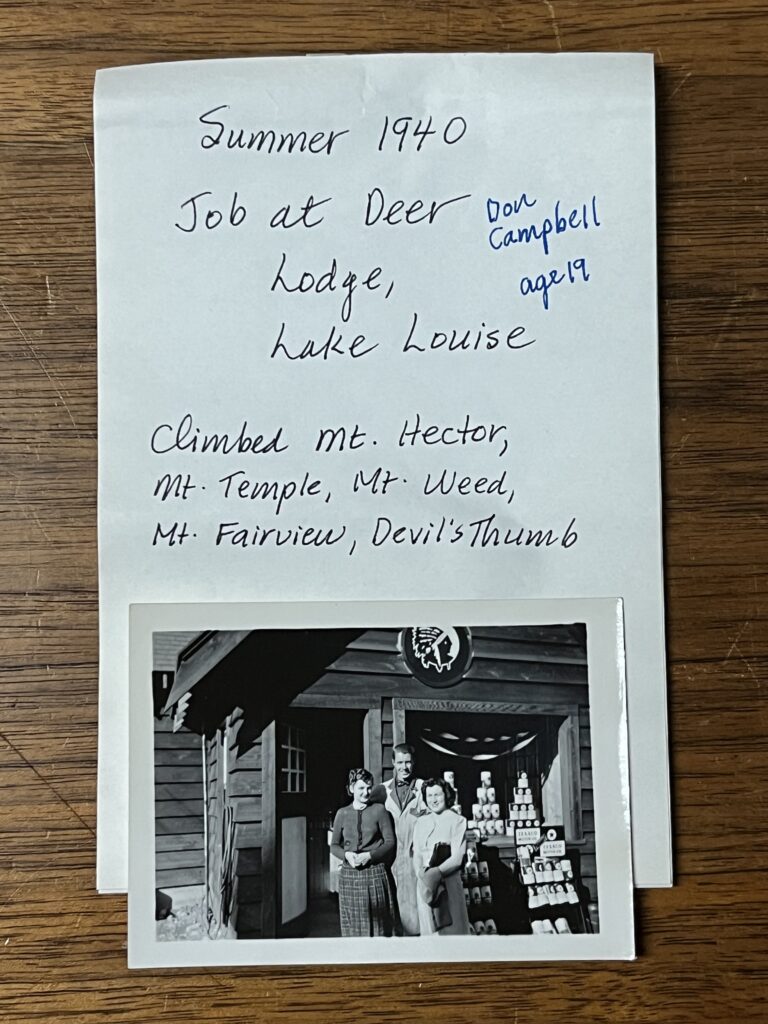
Don Campbell, age 19, at his Summer 1940 job at Deer Lake Lodge, Lake Louise. That summer he climbed Mt. Hector, Mt. Temple, Mt. Weed, Mt. Fairview, and Devil’s Thumb.
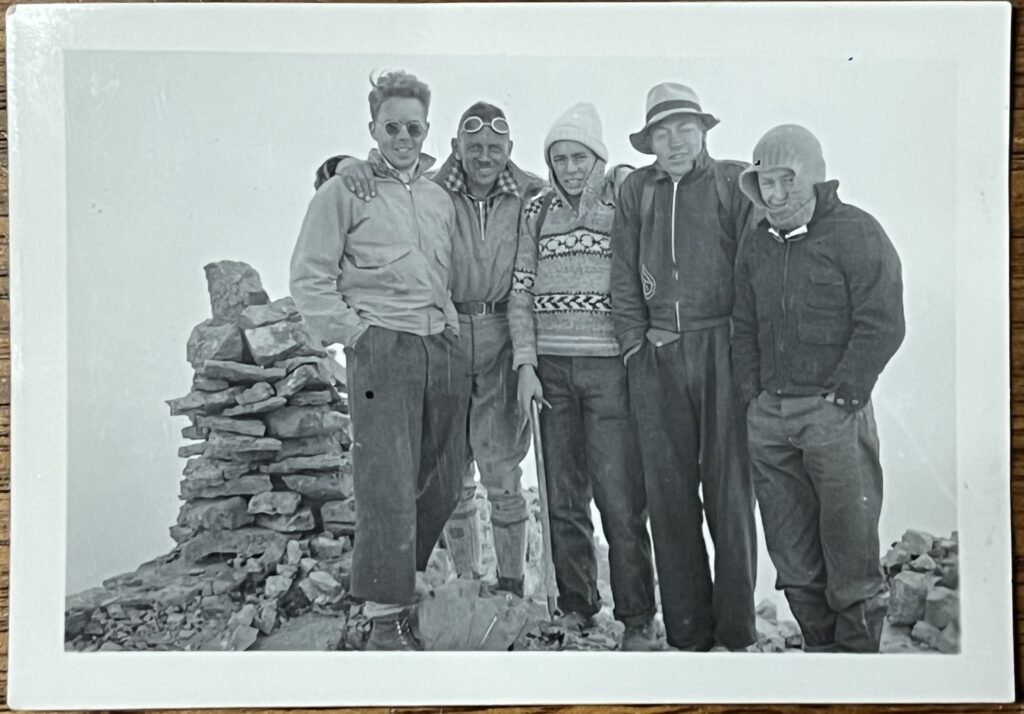
Don Campbell (center) with Rex Gibson (left) at Mt. Weed summit, 3080 metres.
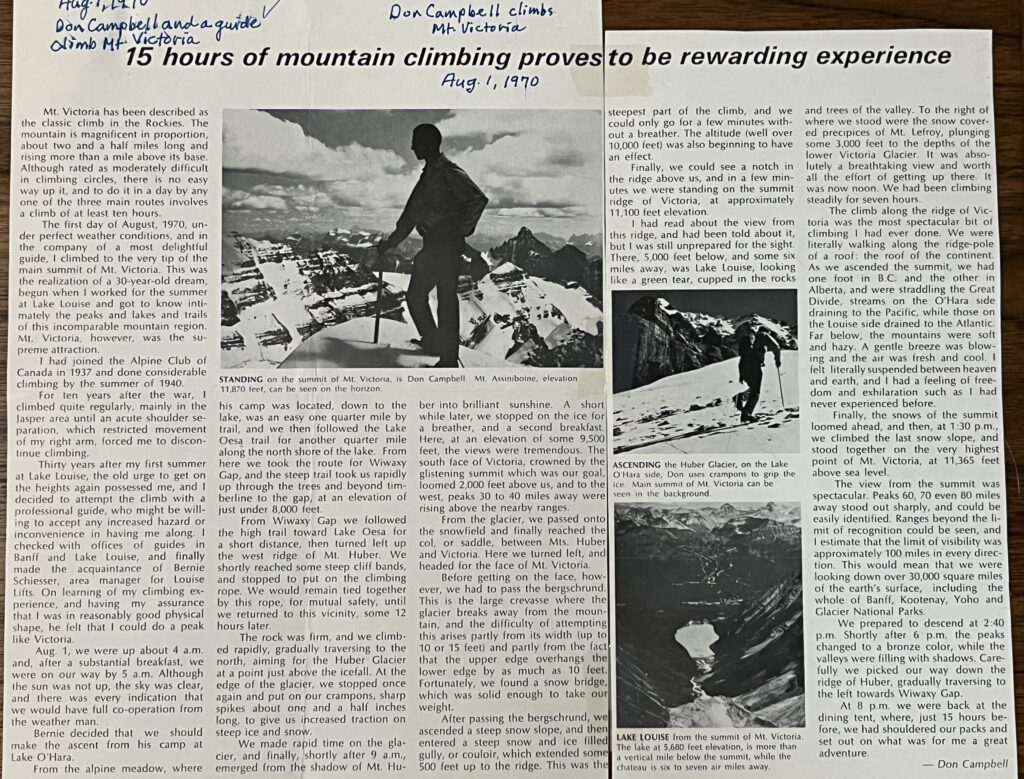
Don wrote about his 1970 trip, which was published in The Courier in January 1971.