By Renee Polziehn
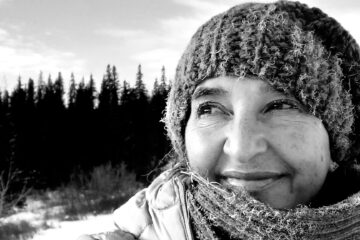
Jo Ann Creore epitomizes the true mountaineering spirit that has dominated the Alpine Club of Canada for generations. Her passion for the mountains has not waned in the nearly fifty years she has lived in Edmonton. Since the 1960s, Jo Ann was an inspiration for men and women interested in the mountains, and her attitude to life is something we should all celebrate.
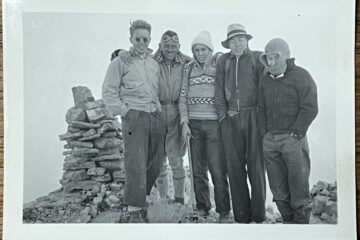
Who is this extraordinary woman? She’s a stranger to nearly everyone entering the Edmonton Section today, but, for at least twenty years, you would have had a hard time finding someone in the club who didn’t know her. If you ever dropped into the Kluane Store in Edmonton, a photo of her is among the mountaineers posted on their walls. Jo Ann started climbing when chest harnesses were considered an upgrade from the rope around the waist. Then, out of the blue, her name re-appeared in the 2011 ACC Gazette with an account of climb on Mt. Kilimanjaro in 2009. At age seventy two, Jo Ann confessed that “this would be, I knew, my last great mountain. There were tears.” To signify the amazing quality of this individual, Jo Ann could have climbed Khilimanjaro as a last hurrah to a lifetime of climbing, but she chose instead to commemorate the climb as a fund raiser for guide dogs in honour of one of her close friends.
Jo Ann arrived in Edmonton in 1966 as a newly hired academic at the University of Alberta’s Department of Romance Language (today known as Modern Languages and Cultural Studies). Her pursuits were strongly rooted in the Arts, and a stroll in the woods would have been as foreign to her as finding Mozart scrambling up the Eiger. She had never been a particularly active person, but a colleague of hers, Ernest Reinhold, convinced her to come to an Edmonton Section meeting. Before she knew it, she was learning to tie knots, and John Tewnion was helping her take her first nerve-wracking steps up Morro Slabs. “Bowel-heaving nervousness” might be more accurate, according to her. Heights were not something that came easily to Jo Ann; she was slow and unfit. So why continue? “I was stubborn and had a big ego,” she said; “I couldn’t believe I could be so bad at something!”
We are so glad you were stubborn, Jo Ann!
What followed, from 1967 to the 1980s, were frequent section outings, camps, and numerous roles on the Executive (Climbing and Skiing Chair, Breeze Editor, and Section Chair); and she was a protagonist in a movement to lead trips for National. For the Section, Jo Ann led trips in the Freshfields, the Hooker Icefield, and Glacier Lake. She also went on National trips to Moat Lake, Farnham Creek, Baffin Island, Battle Ranges, several ski camps, and was the Camp Manager at Fryatt. She watched the transition away from chest harnesses to using both chest and seat harnesses after a climber slipped out of his chest harness on Yamnuska and met a tragic end. In 1978, she was only the fifth woman to receive a Silver Rope Award in the Club’s long history – in 2012, there are still less than ten women that hold this honour. “I took up leading so that I could set the pace of the party,” jokes Jo Ann. Even today, Jo Ann still seems surprised at her award. “I never lost anyone,” she says, laughing. When Jo Ann refers to her own climbing, she modestly says that if she was not a good climber, at least she was one who was not a complete hazard on the mountain.
“Mountains have been an overriding part of my life – with the exception of Mike [Street],” her life partner. “They have given me so much, and I owe the club so much. Mountains taught me that you have to be honest about your goals. I climb for the sheer joy of it. I didn’t care how I got there – so if I needed a guide, I would hire one.” Through hiring guides, she has built a library of memorable experiences and was not limited by the less flexible schedules of her colleagues. In 1977, she stayed at the house of Hans Mueller for a month, an experience she repeated for several summers. Yes, the same Hans Mueller renowned for his Eiger North Face ascent. With him, she climbed the Mönch, Jungfrau, Eiger, Mt. Blanc, Doldenhorn, Vorderspitze, and at least thirty other ascents in the Alps, not including those in Italian Dolomites. Jo Ann recalls her back was so badly seized one year that Hans had to tie her boots before she could go climbing. Somehow, her injury never bothered her while climbing, and the schnapps and codeine made the nights bearable. Leading on snow was Jo Ann’s strength, and, while she led the west ridge of Perdrix and Grillmairs Chimney, she got up a lot of other rock routes with the aid of “a very tight rope.”
“Between 1971 and 1972, all I did was go to funerals. There was the traverse on Tunnel Mountain, one on Yamnuska, three on Edith Cavell. Pete Ford survived and dug out Jim Carlson, who was still alive and died in the helicopter.” Jo Ann likely would have continued her list, for as anyone in the climbing community knows, everyone who plays in the mountains for any length of time will lose friends, but our conversation moved on to near misses. We are happy to laugh now about the novice on a ski trip who was roped to Jo Ann. Jo Ann had gotten her skis into a crevasse and was contemplating how to extract herself from her precarious position. Suddenly, the newbie skied up to her to ask, “How can I help?” to which Jo Ann responded with a number of expletives. Few know better than Jo Ann how involved a glacier rescue can be, as she had been involved in a multi-rope team rescue involving two climbing parties on the Columbia Icefields.
After a fantastic trip to Nepal 1972 with Mountain Travel, where Jo Ann learned she could tolerate high altitude, Jo Ann signed up for their 1975 trip to Denali, the Alaskan giant and highest mountain in North America. What a trip of a lifetime that turned out to be! There appeared to be no screening of clients. Perhaps the guide’s own success in 1967 on the mountain (without any previous experience) gave him hope that anyone could reach the cold summit. On the first night out, one client was so hypothermic that he could not get himself into his tent. It wasn’t until hours passed that the client was found helpless outside his tent and had to be flown out. “In hindsight I should have joined him on the flight”, said Jo Ann, “but I was still a novice.” The following days were like a never-ending scene from The Three Stooges. “Who’s on first and who’s on second base camp?” The guide was running unroped back and forth between the different groups spread across the face of the mountain, screaming at them to keep their ice axes in their right hand. Under no circumstance were they to switch hands. How was the decision made on who should go to the summit from the high camp at 17,200 feet? “…Our leader decided that the best way to sort out who would go to the summit next day was to have us run around in a circle and see who lasted the longest.” Lucky for Jo Ann, she did not suffer from being at altitude like many of the other clients. All the rope teams operated independently on summit day, and Jo Ann’s team was one of two who made it to the summit; however, they were trapped by a storm at a high bivouac. They took shelter for three days in two tents, thirteen people in six sleeping bags. Eventually, only half of the group made it to the summit, and everyone returned to base camp. “Our guide had insulted the pilot so much that he wouldn’t fly us out. Other pilots took pity, even left us beer, and eventually we got out.”
In 1977, she joined a guided trip to Logan that included Edmonton section members John Adler and Ursula Maydell. This was the same year that Kathy Calvert, Diana Knaak, Judy Sterner, Lorraine Drewes, Cathy Langhill, and Sharon Wood made the first all-women’s ascent on Canada’s largest peak. “This was a great trip … even though John got frostbite and had to be flown out.” Ursula and Jo Ann made it to the east summit.
Huascaran, in 1981, was another big trip, and while they had a competent guide this time, the trip changed the type of adventures that she would later interest her. Was it the horrendous storm that came through – the type where you use your feet and arms to brace the tent poles? The avalanches? Was it the hazard of crevasses and icefall? All of these factors were present on her Peruvian climb. But no – it was the decision she made between going to the summit at the sacrifice of choosing a safe return. At the equator, the sun sets at six pm, and there is no twilight. Jo Ann’s group chose to go to the summit, even though it meant a return in the dark, and uncertainty of returning to their tents. When they returned to lower elevations, Jo Ann reflected on the decision by saying that “it was foolish – I will kill myself if I keep doing this.” She knew her brain was not making the right decisions at 22,300 ft. Is climbing crazy? “No! Well at points of a climb I may answer that differently!”
Section trips were shared with other women and bring a lifetime of happy moments. Monique Robitaille had taken a mountaineering course where they had learned to build igloos. Convincing section members this was possible, Monique led a section trip onto the Wapta Icefield only to discover that “building an igloo for one was quite different than for an entire party. Eventually, they built a pit and threw a tarp on for a roof.” Only the snoring Scotsman, snuggled in his sleeping bag, seemed to be oblivious to the world. Then, there was the delightful trip where they planned to build snow caves on the icefield in lieu of bringing a tent. Poor planning since they arrived to find only a thin layer of snow, and all night long Jo Ann would hear people grumbling as they tried to pick into the ice trying to find some shelter from the cooling night. When asked why Jo Ann wrote the 1992 book, Snow Camping: the Complete Guide to Enjoying the Back Country, she replied, “Everything was written about the USA, and they didn’t have to deal with minus-forty conditions.” I wonder if it didn’t have something to do with the large number of abandoned igloos on the Columbia Icefield over the years and a vast number of experiences gleaned from everyone’s misadventures! The book was a revelation to many, including CBC television and radio, which interviewed and televised Jo Ann showing that people could enjoy camping in snow. While Jo Ann chuckles that it was never a best seller, her book still remains one of the top resources on winter camping.
“I met Mike in the eighties on a section trip… I think in the Tonquin Valley, perhaps on the same trip where Monique Robitaille was sleeping in a snow cave with her baby – perhaps to prove you could do it!” Their first climb together was on Mt. Rhonda, and, while Mike was not a big climber, he did make it up Kain Face on Mount Robson. However, Mike’s schedule did not match with ACC trips, so they eventually abandoned doing trips with the club. One of their more memorable ski strips was a traverse on Baffin (Explore Magazine, 1990), and they both enjoyed hiking.
Although Jo Ann had been skiing for a while as a means to get around the mountains, her introduction to the joys of telemark skiing was at Parker’s Ridge with Ken Jones. Jo Ann started skiing on alpine touring (AT) gear, but switched to telemark skiing depending on the trip. “Powder hound” and “yo-yo skiing” have likely never been part of Jo Ann’s vocabulary, but, with a side slip, snow plow, and kick turn, she could maneuver through most mountain terrain, including the famous Haute Route in Europe. She made ski ascents on various peaks from those on the Dias Glacier by Mt. Waddington with Al Schaefer, and had several visits to the Durrand Glacier Chalet. Her observation of skiing on glaciers will ring true for most section members, bringing back both memories of misery and comedy. “A roped party skiing downhill is never standing up at the same time.” Jo Ann eventually moved to downhill gear, and, as someone who will try something new at least once, she did one heli-ski trip with Mike. Never having mastered skiing powder and steep gullies, she surmised that “once was more than enough.” Jo Ann has now switched to snow shoeing. “You don’t need to watch what your feet are doing and can focus on the mountains.” You also can keep yourself amused with all the animal tracks while slogging up a trail “trying to figure out who has been doing what last night.”
Jo Ann continues to do a lot of solo hiking, especially now with the availability of lightweight gear, when a thirty-five-pound pack will take her through five days of camping. “If you didn’t do it before you retire, you likely won’t do it after you retire.” She does most of her solo hiking in the mountain national parks, where there is less bear hazard and more likely someone will come along if you get into trouble. This is not to say she hasn’t had her share of bear encounters, and, indeed, just last year, she was faced with the issue of a bear between her and her tent at Curator Lake. Hmm, where was your bear spray? “In the tent,”’ she laughed, “and I had to muster up as much confidence as I could to calmly walk to my tent,” when the bear sauntered over to the creek.
While Jo Ann has traveled to nearly every continent in the world, the cooler climates tug at her heart. She has her eye on Banks Island on the Thomsen River, and has already knocked off the Nahanni, Burnside, Tatshenshini, and Firth Rivers. The Antarctic is still on her bucket list. She says, though, that she has come to realize that four legs are even better than two with ski poles. Her trip to Mongolia after 2006 endeared horse travel to her, so much so that she sought out a horse trip at Patagonia. Coming up short for horse-led trips in these mountains, she relented and decided to go to Mexico to try a trip on the Valle de Bravo. In her blog, Jo Ann writes about fear. “Funny thing about fear: you defeat it in one place and it promptly crops up in another. Right now I’m afraid of my next riding lesson…. Realistic fear drives me to prepare for danger, and being prepared, I am less afraid.”
Unfortunately, she fell off her horse in Mexico and broke her arm. The blessing is that she had to cancel her trip to northern Greenland, where she had planned to stay with Thule Inuit as a passenger on a dog team on the pack ice. Why a blessing? Jo Ann was available for an interview! When I asked her how she faired with the food in Mongolia, she replied that they had a Tanzanian cook during the trek. “Did I bring any food? No, just coffee!” she laughed. For anyone wanting to arrange a private trip, food can be found at tourist camps.
Jo Ann’s stories of her climbing escapades could fill a book, one that I hope that she may write, as I barely have scratched at the great well of humour that bubbles under her surface and the numerous people who have joined her journeys. Her advice to women – “DO IT, find a good group to go with, learn the basics, and take lessons.” Are women really any different than men? “Women are generally more conservative and plan more. That said, Bill McIntosh would agonize over a rappel, and I have been known to rappel off a vegetable.”
Bless your heart Jo Ann for your adventurous soul and the inspiration you gave to so many people to seek fulfillment in the mountains.
For more details on Jo Ann’s adventures, see her website and photo collections:



0 Comments